
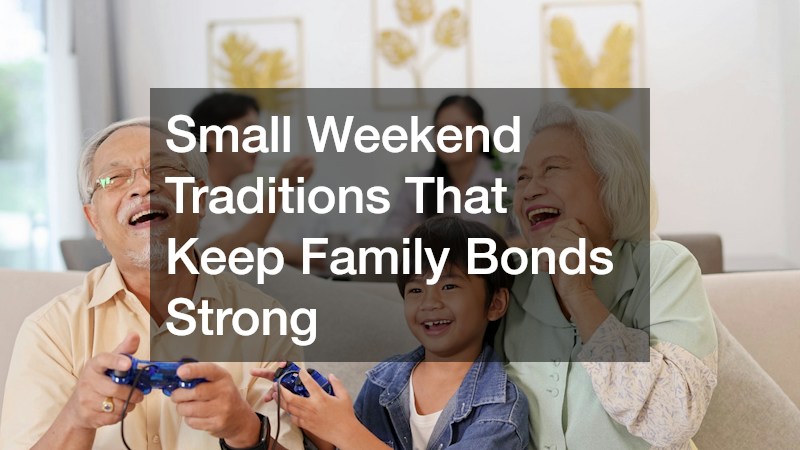
Weekends pass faster than most families expect. Between errands, screens, and the general pull of individual routines, Saturday and Sunday can slip by without a single moment that feels genuinely shared. Research on family cohesion consistently points to the same finding: it isn’t grand vacations or milestone events that hold families together over time — it’s the small, repeated rituals that accumulate into something larger. The question isn’t whether to create traditions, but which kinds actually stick, and how to build them without turning them into obligations.
Why Repetition Matters More Than Occasion
There’s a meaningful difference between a one-time family experience and a tradition. A tradition carries anticipation — everyone involved knows it’s coming, and that expectation itself becomes part of the value. Developmental psychologists studying family rituals have noted that predictable routines give children a stronger sense of identity and belonging, separate from any fun the activity itself delivers.
The practical implication is that simplicity isn’t a compromise — it’s the point. A tradition that requires significant planning or expense is vulnerable to cancellation. One that takes thirty minutes and needs no preparation can survive a hectic week.
What tends to erode weekend traditions isn’t lack of interest; it’s inconsistency. Families often start something in an energized moment and let it drift when life gets busy. Treating a tradition like a standing appointment — same time slot, same general shape — removes the decision fatigue that causes drift.
Three approaches worth comparing:
- Scheduled traditions (same time every week, like Saturday morning pancakes at 8:30 a.m.) build the strongest anticipation and require the least ongoing negotiation.
- Flexible traditions (same activity, shifting timing based on the week) stay alive longer during busy seasons but lose some of the automatic quality that makes rituals powerful.
- Seasonal traditions (specific to a time of year) add novelty and are easier to sustain, but they don’t provide the week-to-week continuity that reinforces bonds throughout the year.
For most families, a combination works best — one or two weekly anchors supplemented by a few seasonal markers.
Building Traditions Around Food Without Overcomplicating It
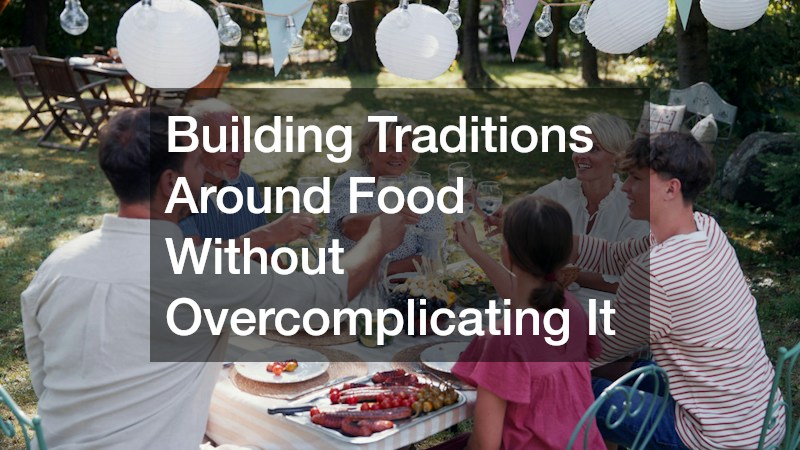
Food is the most durable platform for family ritual, and the reason is practical: everyone already eats. There’s no extra time required and no skill threshold that excludes younger children. The tradition doesn’t live in the food itself — it lives in who makes it, how it’s made, and what happens around it.
A Saturday breakfast where each family member chooses one ingredient to add to a shared recipe gives children a sense of ownership and adults a low-stakes creative outlet. Over months, the recipe evolves, and so does everyone’s memory of it. That accumulation is exactly what transforms a habit into a tradition.
The comparison that trips many families up is between cooking together and eating out. Both can anchor a weekend ritual, but they work differently. Cooking together is slower, messier, and more interactive — it creates shared memories through process, not just outcome. A trip to the local diner on Sunday mornings can become just as meaningful if it’s consistent and treated as protected time, but it tends to favor conversation over collaboration.
One practical observation: traditions involving food are most likely to survive adolescence when teenagers have some control over them. Letting a twelve-year-old own one step of a recipe — or choose the spot once a month — extends the tradition’s life considerably.
Outdoor and Movement-Based Rituals

Physical activity offers something food traditions don’t: it changes as children grow, which means the tradition can scale with the family rather than aging out. A Saturday walk that starts as a stroller outing becomes a hike, then a run, then something a teenager might actually choose to show up for.
The error families make here is tying the tradition too tightly to a specific activity rather than a specific slot. When a child loses interest in bike rides, the tradition appears to be over — but what’s actually over is just the format. Keeping the time protected and renegotiating what happens in it is a stronger strategy than defending the original activity.
Comparison worth making: structured activities versus unstructured outdoor time. Organized sports leagues and classes serve developmental goals, but they’re led by someone else. An unstructured family walk or backyard game puts parents in the position of being present without being instructors. That shift in dynamic — from supervising to simply being together — is harder to replicate in structured settings and matters more as children get older.
Practical notes for making movement traditions stick:
- Anchor the outing to a consistent departure time (even 20-minute windows, like leaving before 9 a.m.) rather than leaving it open-ended, which reliably leads to delays.
- Build in at least one element of choice — route, destination, or who picks the next week’s activity — so older children maintain a sense of agency.
- Keep the minimum viable version of the tradition small enough to do even on a difficult weekend; thirty minutes outside counts.
Screen-Based Traditions Done Intentionally
Screens aren’t automatically the enemy of family connection — the problem is passive, individual consumption mistaken for shared experience. A Friday night film tradition watched together, discussed afterward, and chosen on a rotating schedule is genuinely connective. Everyone queued to separate devices in the same room is not.
The distinction matters because families trying to eliminate screens from weekend traditions often create unnecessary friction. A more productive frame is intentionality: what makes a screen tradition work is that it’s collective, bounded, and followed by something — conversation, a walk, a game.
Rotating who chooses the film or show each week transfers ownership and teaches everyone’s preferences to everyone else. A teenager who picks something an eight-year-old ends up loving has an experience that doesn’t come from any other weekend activity.
- Set a fixed start time for the shared viewing (Friday at 7 p.m., for example) so it becomes a marker that ends the week’s stress rather than requiring weekly negotiation.
- Follow the viewing with a no-phones, ten-minute conversation about one thing each person noticed — not a formal debrief, just an expectation that the experience doesn’t end when the credits roll.
- Rotate choosing rights on a written schedule so the decision doesn’t default to whoever advocates loudest.
Starting Simply and Letting Traditions Grow
The families with the most durable weekend rituals rarely designed them deliberately. Most began with something convenient that happened to repeat — and then protected it when it started mattering. That’s actually a useful model: try something low-effort for four or five consecutive weekends, and pay attention to whether it generates anticipation. If it does, it’s worth formalizing into a standing tradition.
The temptation is to start with something elaborate and meaningful. The outcome, more often, is a tradition that never makes it past the first month. Start with whatever takes less than an hour and requires nothing that can run out of stock or get rained out indoors. Let complexity arrive later, when the ritual has already earned its place in the week.